Patrick Rampino Who Passed Away Family Came From Hyde Park 2017 December 2nd
| Hyde Park | |
|---|---|
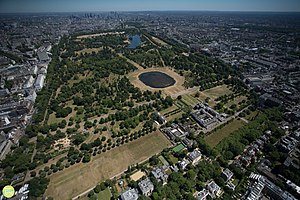 Hyde Park and Kensington Gardens (in foreground) | |
| Location within key London | |
| Type | Public park |
| Location | London, England |
| Coordinates | 51°30′31″Northward 0°09′49″Westward / 51.508611°N 0.163611°W / 51.508611; -0.163611 Coordinates: 51°xxx′31″N 0°09′49″Westward / 51.508611°North 0.163611°W / 51.508611; -0.163611 |
| Area | 350 acres (140 ha) |
| Created | 1637 (1637) [one] |
| Operated by | The Imperial Parks |
| Status | Open year round |
| National Register of Historic Parks and Gardens | |
| Official proper noun | Hyde Park |
| Designated | 1 Oct 1987 |
| Reference no. | 1000814 |
| Website | www |


Hyde Park is a Form I-listed major park in Key London. It is the largest of four Royal Parks that form a chain from the archway of Kensington Palace through Kensington Gardens and Hyde Park, via Hyde Park Corner and Light-green Park by the primary archway to Buckingham Palace. The park is divided past the Serpentine and the Long H2o lakes.
The park was established past Henry Viii in 1536 when he took the land from Westminster Abbey and used it as a hunting ground. It opened to the public in 1637 and apace became popular, particularly for May Day parades. Major improvements occurred in the early 18th century nether the direction of Queen Caroline. Several duels took identify in Hyde Park during this fourth dimension, oftentimes involving members of the nobility. The Cracking Exhibition of 1851 was held in the park, for which The Crystal Palace, designed by Joseph Paxton, was erected.
Free speech and demonstrations have been a key feature of Hyde Park since the 19th century. Speakers' Corner has been established every bit a indicate of costless oral communication and fence since 1872, while the Chartists, the Reform League, the suffragettes, and the Stop the War Coalition accept all held protests in that location. In the belatedly 20th century, the park was known for property large-calibration free rock music concerts, featuring groups such equally Pink Floyd, The Rolling Stones and Queen. Major events in the park have connected into the 21st century, such as Alive 8 in 2005, and the annual Hyde Park Winter Wonderland from 2007.
Geography [edit]
Hyde Park is the largest Royal Park in key London. It is divisional on the north by Bayswater Road, to the east by Park Lane, and to the south by Knightsbridge. Farther north is Paddington, further east is Mayfair and further south is Belgravia.[two] To the southeast, outside the park, is Hyde Park Corner, beyond which is Green Park, St. James's Park and Buckingham Palace Gardens.[3] The park has been Course I listed on the Register of Historic Parks and Gardens since 1987.[4]
To the west, Hyde Park merges with Kensington Gardens. The dividing line runs approximately between Alexandra Gate to Victoria Gate via West Railroad vehicle Drive and the Serpentine Bridge. The Serpentine is to the south of the park area.[2] Kensington Gardens has been separate from Hyde Park since 1728, when Queen Caroline divided them. Hyde Park covers 142 hectares (350 acres),[5] and Kensington Gardens covers 111 hectares (275 acres),[half-dozen] giving a total expanse of 253 hectares (625 acres).[a] During daylight, the two parks merge seamlessly into each other, simply Kensington Gardens closes at dusk, and Hyde Park remains open up throughout the twelvemonth from five a.m. until midnight.[3]
History [edit]
Early history [edit]
The park's name comes from the Manor of Hyde, which was the northeast sub-division of the manor of Environmental impact assessment (the other ii sub-divisions were Ebury and Neyte) and appears equally such in the Domesday Volume.[7] The name is believed to be of Saxon origin, and ways a unit of land, the hibernate, that was advisable for the back up of a unmarried family and dependents.[viii] Through the Eye Ages, it was property of Westminster Abbey, and the forest in the estate were used both for firewood and shelter for game.[7]
16th–17th centuries [edit]
Hyde Park was created for hunting by Henry Vlll in 1536 afterwards he acquired the manor of Hyde from the Abbey.[9] It was enclosed equally a deer park and remained a private hunting ground until James I permitted limited admission to gentlefolk,[10] appointing a ranger to take accuse. Charles I created the Ring (north of the present Serpentine boathouses), and in 1637 he opened the park to the general public.[11] It quickly became a popular gathering place, specially for May Day celebrations. At the start of the English language Civil War in 1642, a series of fortifications were built along the east side of the park, including forts at what is now Marble Arch, Mountain Street and Hyde Park Corner. The latter included a strongpoint where visitors to London could be checked and vetted.[2]
In 1652, during the Interregnum, Parliament ordered the and then 620-acre (250 ha) park to be sold for "fix money". Information technology realised £17,000 with an additional £765 6s 2d for the resident deer.[12] [13] During the Peachy Plague of London in 1665, Hyde Park was used as a military camp.[2] Post-obit the Restoration of the Monarchy in 1660, Charles Two retook ownership of Hyde Park and enclosed information technology in a brick wall. He restocked deer in what is now Cadet Hill in Kensington Gardens. The May Day parade continued to be a popular event; Samuel Pepys took office in the park'due south celebrations in 1663 while attempting to proceeds the Rex's favour.[14]
18th century [edit]

In 1689, William 3 moved his residence to Kensington Palace on the far side of Hyde Park and had a drive laid out across its southern border which was known every bit the King's Private Road. The drive is still in beingness as a wide straight gravelled wagon track leading due west from Hyde Park Corner across the southern boundary of Hyde Park towards Kensington Palace and now known as Rotten Row, peradventure a corruption of rotteran (to muster),[7] Ratten Row (roundabout way), Route du roi, or rotten (the soft fabric with which the road is covered).[xv] Information technology is believed to be the first road in London to be lit at night, which was done to deter highwaymen. In 1749, Horace Walpole was robbed while travelling through the park from Holland House.[xvi] The row was used by the wealthy for riding in the early 19th century.[17]
Hyde Park was a popular duelling spot during the 18th century, with 172 taking place, causing 63 deaths.[18] The Hamilton–Mohun Duel took place there in 1712, when Charles Mohun, 4th Businesswoman Mohun fought James Hamilton, fourth Duke of Hamilton. Baron Mohun was killed instantly, and the Duke died presently later. John Wilkes fought Samuel Martin in 1772, the year in which Richard Brinsley Sheridan duelled with Helm Thomas Mathews over the latter's libellous comments most Sheridan's fiancée, Elizabeth Ann Linley. Edward Thurlow, 1st Businesswoman Thurlow, fought Andrew Stuart in a Hyde Park duel in 1770.[16] Military executions were common in Hyde Park at this time; John Rocque's Map of London, 1746, marks a point within the park, close to the Tyburn gallows, as "where soldiers are shot."[nineteen] [b]
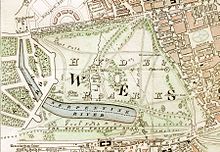
Hyde Park c. 1833: Rotten Row is "The King's Private Route"
The first coherent landscaping in Hyde Park began in 1726. It was undertaken by Charles Bridgeman for King George I; after the king'south death in 1727, it connected with approval of his girl-in-constabulary, Queen Caroline.[xvi] [21] Work was supervised by Charles Withers, the Surveyor-Full general of Woods and Forests. The principal effect work was to Hyde Park and create Kensington Gardens.[22] [c] The Serpentine was formed by damming the River Westbourne, which runs through the park from Kilburn towards the Thames. Information technology is divided from the Long Water by a bridge designed by George Rennie in 1826.[16]
The work was completed in 1733. The 2nd Viscount Weymouth was made Ranger of Hyde Park in 1739 and soon after began digging the Serpentine lakes at Longleat.[23] A powder magazine was built north of the Serpentine in 1805.[16]
19th–21st centuries [edit]

Hyde Park, 1890, by Camille Pissarro, showing the footpath along the southern bank of the Serpentine
Hyde Park hosted a Great Fair in the summertime of 1814 to gloat the Allied sovereigns' visit to England, and exhibited various stalls and shows. The Battle of Trafalgar was re-enacted on the Serpentine, with a band playing the National Canticle while the French fleet sank into the lake. The coronation of King George IV in 1821 was celebrated with a fair in the park, including an air balloon and firework displays.[xvi]
1 of the most important events to take identify in Hyde Park was the Great Exhibition of 1851. The Crystal Palace was constructed on the south side of the park.[sixteen] The public did not want the building to remain after the closure of the exhibition, and its architect, Joseph Paxton, raised funds and purchased it. He had it moved to Sydenham Colina in South London.[24] Another meaning event was the first Victoria Cross investiture, on 26 June 1857, when 62 men were decorated by Queen Victoria in the presence of Prince Albert and other members of the Royal Family, including their future son-in-law Crown Prince Frederick William of Prussia.[25]
The Hyde Park Lido sits on the s bank of the Serpentine. Information technology opened in 1930 to provide improved support for bathing and sunbathing in the park, which had been requested by the naturist group, the Sunlight League. The Lido and accompanying Pavilion was designed by the Commissioner of Works, George Lansbury, and was half funded by a £v,000 (now £323,000) donation from Major Colin Cooper (1892–1938). It nevertheless sees regular employ in the summer into the 21st century.[26] [27]
Hyde Park has been a major venue for several Royal jubilees and celebrations. For the Gilt Jubilee of Queen Victoria in 1887, a party was organised on 22 June where around 26,000 school children were given a free meal as a gift. The Queen and the Prince of Wales made an unexpected appearance at the event. Victoria remained fond of Hyde Park in the final years of her life and often drove in that location twice a day.[28] As part of the Queen'due south Silver Jubilee in 1977, a Jubilee Exhibition was set up in Hyde Park,[27] with the Queen and Prince Philip visiting on thirty June.[29] In 2012, a major festival took place in the park every bit part of the Queen's Diamond Jubilee celebrations.[30] On half dozen February, the King's Troop, Royal Horse Artillery fired a 41-gun Regal Salute at Hyde Park Corner.[31]

The Winter Wonderland festival has been a popular Christmas issue in Hyde Park since 2007.
On xx July 1982, a Provisional Irish Republican Ground forces bomb killed four soldiers and seven horses.[32] A memorial was constructed to the left of the Albert Gate to commemorate the soldiers and horses killed in the blast.[33]
Since 2007, Hyde Park has played host to the annual Winter Wonderland outcome, which features numerous Christmas-themed markets, forth with various rides and attractions, alongside bars and restaurants. It has become one of the largest Christmas events in Europe, having attracted over 14 million visitors as of 2016,[34] and has expanded to include the largest ice rink in London, alive entertainment and circuses.[35]
On 18 September 2010, Hyde Park was the setting for a prayer vigil with Pope Bridegroom 16 as office of his visit to the United kingdom of great britain and northern ireland, attended by around 80,000 people. A large crowd assembled along the Mall to see the Pope arrive for his address.[36] [37] An attempt to assassinate the Pope had been foiled after five people dressed as street cleaners were spotted inside a mile of Hyde Park, and arrested along with a sixth suspect.[38] They were later released without charge as police said they posed no apparent threat.[39]
Grand Entrance [edit]
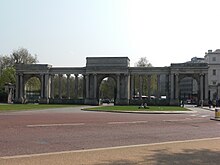
During the late 18th century, plans were fabricated to replace the old toll gate at Hyde Park Corner with a grander archway, following the gentrification of the expanse surrounding it. The first pattern was put forward by Robert Adam in 1778 equally a thousand archway, followed past John Soane's 1796 proposal to build a new palace adjacent to the corner in Green Park.[40]
Following the construction of Buckingham Palace, the improvement plans were revisited. The grand archway to the park at Hyde Park Corner was designed by Decimus Burton, and was constructed in the 1820s.[twoscore] Burton laid out the paths and driveways and designed a series of lodges, the Screen/Gate at Hyde Park Corner (likewise known as the Yard Archway or the Apsley Gate) in 1825[16] and the Wellington Arch, which opened in 1828.[41] The Screen and the Curvation originally formed a single limerick, designed to provide a monumental transition between Hyde Park and Light-green Park, although the arch was moved in 1883. It originally had a statue of the Knuckles of Wellington on height; it was moved to Aldershot in 1883 when the arch was re-sited.[41]

An early on description reports:
"Information technology consists of a screen of handsome fluted Ionic columns, with three carriage archway archways, two-human foot entrances, a social club, etc. The extent of the whole frontage is nigh 107 ft (33 m). The central entrance has a bold projection: the entablature is supported by four columns; and the volutes of the capitals of the outside column on each side of the gateway are formed in an angular direction, so as to showroom two complete faces to view. The two side gateways, in their elevations, present two insulated Ionic columns, flanked past antae. All these entrances are finished past a blocking, the sides of the key one being decorated with a cute frieze, representing a naval and military triumphal procession. This frieze was designed by Mr. Henning, junior, the son of Mr. Henning who was well known for his models of the Elgin Marbles. The gates were manufactured past Messrs. Bramah. They are of iron, bronzed, and fixed or hung to the piers past rings of gun-metallic. The design consists of a beautiful arrangement of the Greek honeysuckle ornament; the parts beingness well defined, and the raffles of the leaves brought out in a most extraordinary style."[42]
The Wellington Arch was extensively restored by English Heritage betwixt 1999 and 2001. It is now open to the public, who can run into a view of the parks from its platforms above the porticoes.[41]
Features [edit]
Popular areas within Hyde Park include Speakers' Corner (located in the northeast corner near Marble Arch), close to the erstwhile site of the Tyburn gallows,[43] and Rotten Row, which is the northern boundary of the site of the Crystal Palace.[3]
Phytology [edit]
Flowers were commencement planted in Hyde Park in 1860 by William Andrews Nesfield. The next year, the Italian H2o Garden was synthetic at Victoria Gate, including fountains and a summer house. Queen Anne'south Alcove was designed by Sir Christopher Wren and was moved to the park from its original location in Kensington Gardens.[16]
During the late 20th century, over nine,000 elm trees in Hyde Park were killed by Dutch elm disease. This included many trees forth the great avenues planted by Queen Caroline, which were ultimately replaced past limes and maples.[twoscore] [44] The park at present holds four acres (1.6 ha) of greenhouses which hold the bedding plants for the Royal Parks. A scheme is bachelor to adopt copse in the park, which helps fund their upkeep and maintenance.[forty] A botanical curiosity is the weeping beech, which is known as "the upside-down tree".[45] A rose garden, designed by Colvin & Moggridge Landscape Architects, was added in 1994.[46]
Monuments [edit]

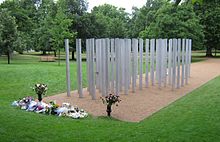
In that location are a number of assorted statues and memorials effectually Hyde Park. The Cavalry Memorial was congenital in 1924 at Stanhope Gate. Information technology moved to the Serpentine Road when Park Lane was widened to traffic in 1961.[47] South of the Serpentine is the Diana, Princess of Wales memorial, an oval stone ring fountain opened on 6 July 2004.[48] To the east of the Serpentine, merely beyond the dam, is London's Holocaust Memorial.[49] The 7 July Memorial in the park commemorates the victims of seven July 2005 London bombings.[l]
The Standing Stone is a 7-tonne (7.7-ton) monolith at the center of the Dell, in the east of Hyde Park. Fabricated of Cornish stone, it was originally part of a drinking fountain, though an urban legend was established, challenge it was brought from Stonehenge by Charles I.[40]
An array of unusual sculptures are scattered around the park, including: Withal Water, a massive horse head lapping upwards h2o; Jelly Baby Family, a family of giant Jelly Babies standing on top of a big black cube; and Vroom Vroom, which resembles a behemothic human mitt pushing a toy car along the ground.[51] The sculptor Jacob Epstein synthetic several works in Hyde Park. His memorial to the author William Henry Hudson, featuring his character Rima caused public outrage when information technology was unveiled in 1925.[16]
There has been a fountain at Grosvenor Gate since 1863, designed by Alexander Munro. There is another fountain opposite Mountain Street on the park'south eastern edge.[16]
A pet cemetery was established at the n border of Hyde Park in the late 19th century.[52] [53] The last burial took identify in 1976.[54]
Debates [edit]

{{{annotations}}}
Hyde Park's Speakers' Corner has caused an international reputation for demonstrations and other protests[55] due to its tolerance of free speech.[56] In 1855, a protest at the park was organised to demonstrate against Robert Grosvenor's attempt to ban Sunday trading, including a restriction on pub opening times. Karl Marx observed approximately 200,000 protesters attended the demonstration, which involved jeering and taunting at upper-course horse carriages. A further protest occurred a week later, only this fourth dimension the police attacked the oversupply.[57]
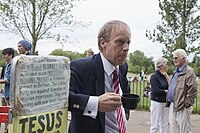
A Protestant Christian protesting at Speakers' Corner in 2010
In 1867 the policing of the park was entrusted to the Metropolitan Constabulary, the but royal park so managed, due to the potential for trouble at Speakers' Corner. A Metropolitan Police force station ('AH') is situated in the middle of the park. Roofing Hyde Park and sixteen other royal parks (mostly in London), the 1872 Parks Regulation Human action formalised the position of "park keeper" and also provided that "Every constabulary constable belonging to the constabulary of the district in which whatsoever park, garden, or possession to which this Act applies is situate shall have the powers, privileges, and immunities of a park-keeper within such park, garden, or possession."[58]
Speakers' Corner became increasingly popular in the late 19th century. Visitors brought along placards, stepladders and soap boxes in club to stand out from others, while heckling of speakers was popular. Donald Soper, Baron Soper was a regular visitor throughout the 20th century, until just before his death in 1998. The rise of the Internet, specially blogs, has diminished the importance of Speakers' Corner as a political platform, and information technology is increasingly seen as simply a tourist attraction.[43]

As well as Speakers' Corner, several important mass demonstrations take occurred in Hyde Park. On 26 July 1886, the Reform League staged a march from their headquarters towards the park, campaigning for increased suffrage and representation. Though the police had airtight the park, the oversupply managed to pause downwards the perimeter railings and go inside, leading to the event being dubbed "The Hyde Park Railings Affair". Later the protests turned violent, three squadrons of Equus caballus Guards and numerous Human foot Guards were sent out from Marble Arch to combat the situation.[59] On 21 June 1908, every bit function of "Women's Sunday", a reported 750,000 people marched from the Beach to Hyde Park protesting for votes for women. The first protest against the planned 2003 invasion of Republic of iraq took identify in Hyde Park on 28 September 2002, with 150,000–350,000 in attendance.[lx] A farther series of demonstrations happened around the globe, culminating in the xv February 2003 anti-war protests, part of a global demonstration against the Republic of iraq War.[61] Over a meg protesters are reported to take attended the Hyde Park issue alone.[threescore]
Concerts [edit]
The bandstand in Hyde Park was built in Kensington Gardens in 1869 and moved to its present location in 1886. Information technology became a popular place for concerts in the 1890s, featuring upward to three every week. Military and brass bands continued to play in that location into the 20th century.[62]

Pink Floyd performing at Live 8 in Hyde Park, ii July 2005, their last of several gigs at the park over their career
The music direction visitor Blackhill Enterprises held the first rock concert in Hyde Park on 29 June 1968, attended past xv,000 people. On the pecker were Pink Floyd, Roy Harper and Jethro Tull, while John Peel subsequently said it was "the nicest concert I've always been to". Afterward, Hyde Park has featured some of the most significant concerts in rock. The supergroup Blind Faith (featuring Eric Clapton and Steve Winwood) played their debut gig in Hyde Park on seven June 1969. The Rolling Stones headlined a concert (afterward released as The Stones in the Park) on v July that yr, two days afterwards the death of founding fellow member Brian Jones, and is now remembered as 1 of the most famous gigs of the 1960s. Pink Floyd returned to Hyde Park on xviii July 1970, playing new material from Atom Heart Mother. All of the early on gigs from 1968 to 1971 were free events, contrasting sharply with the later commercial endeavours.[63]
Queen played a free concert organised by Richard Branson in the park on 18 September 1976, partway through recording the album A Twenty-four hour period at the Races. The band drew an audience of 150,000 – 200,000, which remains the largest oversupply for a Hyde Park concert. The group were not allowed to play an encore, and police threatened to arrest frontman Freddie Mercury if he attempted to practise so.[64]
The British Alive 8 concert took place in Hyde Park on two July 2005, as a concert organised by Bob Geldof and Midge Ure to raise awareness of increased debts and poverty in the third globe. Acts included U2, Coldplay, Elton John, R.E.M., Madonna, The Who and Paul McCartney, and the most predictable fix was the reformation of the archetype 1970s line-upward of Pink Floyd (including David Gilmour and Roger Waters) for the showtime time since 1981.[65] The gig was the Floyd'due south final alive performance.[66]
Acts from each of the iv nations in the Uk played a gig in the park as function of the opening ceremony for the 2012 Summer Olympics. The headliners were Duran Duran, representing England, alongside the Stereophonics for Wales, Paolo Nutini for Scotland and Snowfall Patrol for Northern Ireland.[67] Since 2011, Radio 2 Live in Hyde Park has taken place each September.[68]
Local residents have become critical of Hyde Park as a concert venue, due to the sound levels, and have campaigned for a maximum sound level of 73 decibels.[69] In July 2012, Bruce Springsteen and Paul McCartney found their microphones switched off later on Springsteen had played a iii-hour set during the Park'due south Hard Rock Calling festival, and overshot the 10:30 pm curfew time.[70]
Sports [edit]
Hyde Park contains several sporting facilities, including several football pitches and a Tennis center. There are numerous cycle paths, and horse riding is pop.[71]
In 1998 British artist Marion Coutts recreated Hyde Park, along with Battersea and Regent's Park, every bit a fix of asymmetrical ping-pong tables for her interactive installation Fresh Air.[72]
For the 2012 Summer Olympics, the park hosted the triathlon, which brothers Alistair Brownlee and Jonathan Brownlee took the Gold and Bronze medals[73] for Team GB, and the ten km open h2o swimming events.[74] The park has also hosted the ITU Earth Triathlon Grand Final.[75]
Transport [edit]

There are five London Underground stations located on or almost the edges of Hyde Park and Kensington Gardens (which is contiguous with Hyde Park). In clockwise order starting from the south-east, they are:[76]
- Hyde Park Corner (Piccadilly line)
- Knightsbridge (Piccadilly line)
- Queensway (Central line)
- Lancaster Gate (Primal line)
- Marble Arch (Central line)
Bayswater tube station, on the Circumvolve and District lines, is also close to Queensway station and the due north-westward corner of the park. High Street Kensington tube station, on the Circle and District is very close to Kensington Palace located on the Southwest corner of Kensington Gardens. Paddington station, served by Bakerloo, Circle and District, and Hammersmith & City lines, is close to Lancaster Gate station and a short walk away from Hyde Park.[76]
Several primary roads run around the perimeter of Hyde Park. Park Lane is role of the London Inner Ring Road and the London Congestion Accuse zone boundary. The A4, a major road through West London, runs along the southeastern edge of the park, while the A5, a major route to Milton Keynes and the Midlands runs northwest from Marble Curvation.[three]
Transport inside the park for people lacking mobility and disabled visitors is provided free of accuse by Liberty Drives, located at Triangle Carpark.[77]
Cycle Superhighway iii (CS3) begins at Lancaster Gate, on the northern perimeter of Hyde Park. It is ane of several TfL-coordinated cycle routes to cross the Park. CS3 also crosses Hyde Park Corner on its road towards Westminster and the City of London. The road opened in September 2018 and is signposted and cyclists are segregated from other road traffic on wide cycle tracks.[78] [79]
Notes [edit]
- ^ By comparison, the combined area of Hyde Park and Kensington Gardens is larger than the Principality of Monaco (196 hectares or 480 acres), though smaller than the Bois de Boulogne in Paris (845 hectares, or 2090 acres), New York Metropolis'due south Central Park (341 hectares or 840 acres), and Dublin's Phoenix Park (707 hectares, or 1,750 acres).
- ^ This location is at present where the A5 Edgware Road meets the A40 Marble Arch.[20]
- ^ Bridgeman was Royal Gardener 1728–38; designed the Round Pond in Kensington Gardens. Peter Willis, Charles Bridgeman and the English language Landscape Garden (London and New York) 1978, devotes a chapter to Bridgeman'south Royal Commissions.
References [edit]
Citations
- ^ "Hyde Park History". Royalparks.org.united kingdom of great britain and northern ireland. fifteen Dec 2003. Archived from the original on xiii January 2006. Retrieved 11 December 2011.
- ^ a b c d Weinreb et al. 2008, p. 423.
- ^ a b c d London A-Z. A-Z Maps / Ordnance Survey. 2004. pp. 164–165. ISBNane-84348-020-iv.
- ^ Historic England, "Hyde Park (1000814)", National Heritage Listing for England , retrieved xi July 2017
- ^ "Hyde Park". Royalparks.org.uk. Archived from the original on 25 September 2010. Retrieved eleven Dec 2011.
- ^ "Kensington Gardens". Royalparks.org.britain. Archived from the original on 27 May 2010. Retrieved 11 Dec 2011.
- ^ a b c Walford, Edward (1878). Hyde Park. Old and New London. Vol. 4. London. pp. 375–405. Archived from the original on 28 January 2017. Retrieved 13 April 2017.
- ^ "Hyde". Dictionary of British Place Names. Oxford University Printing. 2012. ISBN978-0-191-73944-half-dozen. Archived from the original on fourteen April 2017.
- ^ Self 2014, p. 28.
- ^ Humphreys & Bamber 2003, p. 284.
- ^ Porter 2000, p. 279.
- ^ Timbs, John (1855). Curiosities of London: Exhibiting the Most Rare and Remarkable Objects of Interest in the Metropolis. D. Bogue. p. 644. Archived from the original on 14 May 2016.
- ^ "House of Eatables Journal Volume vii: 27 November 1652". British History Online . Retrieved 17 March 2017.
- ^ Weinreb et al. 2008, pp. 423–424.
- ^ E Cobham Brewer. 'Dictionary of Phrase and Fable. Henry Altemus, 1898; Bartleby.com, 2000. Archived from the original on x Oct 2008. Retrieved 29 January 2009.
- ^ a b c d e f g h i j m Weinreb et al. 2008, p. 424.
- ^ Dunton, Larkin (1894). The World and its People. Silver, Burdett. p. 30.
- ^ Rabbitts 2015, p. 49.
- ^ Rabbitts 2015, p. 37.
- ^ John Rocque's Map of London (Map). 1746. Archived from the original on iv July 2017.
- ^ Rabbitts 2015, p. 112.
- ^ Rabbitts 2015, p. 40.
- ^ Timothy Mowl, "Rococo and Later Landscaping at Longleat", Garden History 23.i (Summer 1995, pp. 56–66) p. 59, noting Jacob Larwood, The Story of London Parks 1881:41.
- ^ Purbrick, Louise: The Great Exhibition of 1851: New Interdisciplinary Essays: 2001: Manchester University Press, p. 122
- ^ Crook, M. J. (1975). The Development of the Victoria Cross. Midas Books. pp. 49–52. .
- ^ Rabbitts 2015, p. 137.
- ^ a b "Hyde Park History & Compages". The Royal Parks. 2007. Archived from the original on 10 August 2007. Retrieved five September 2007.
- ^ Rabbitts 2015, p. 91.
- ^ "Court Round". The Times. London, England. ane July 1977. p. 20. Archived from the original on 14 May 2016. Retrieved 16 August 2017.
- ^ "Sainsbury's announces Jubilee Family Festival". Majestic Parks. 17 Feb 2012. Archived from the original on 17 Apr 2017. Retrieved 16 Apr 2017.
- ^ "Gun salutes marking Queen's Diamond Jubilee". The Daily Telegraphy. vi Feb 2012. Archived from the original on 2 May 2017. Retrieved 16 August 2017.
- ^ "1982: IRA bombs cause carnage in London". BBC News. 20 July 1982. Archived from the original on eight March 2014. Retrieved 25 January 2014.
- ^ Rabbitts 2015, pp. 137–138.
- ^ "Hyde Park Winter Wonderland". PWR Events. Archived from the original on xx Dec 2016. Retrieved 8 December 2016.
- ^ Addison, Harriet (26 Nov 2011). "Go your skates on this weekend". The Times. London, England. p. 3 [S1]. Archived from the original on fourteen May 2016. Retrieved 16 August 2017.
- ^ "Pope tells Hyde Park oversupply that 'they too suffer for their religion'". The Guardian. 18 September 2010. Archived from the original on 17 April 2017. Retrieved 16 Apr 2017.
- ^ Owen, Richard (20 September 2010). "Great for a man maligned as a Teutonic hardliner". The Times. London, England. p. 8. Archived from the original on 14 May 2016. Retrieved xvi Baronial 2017.
- ^ Brown, David; Gledhill, Ruth; Fresco, Adam (18 September 2010). "Pope's rallying cry". The Times. London, England. p. 1. Retrieved 16 Baronial 2017.
- ^ "Pope 'plotter' still traumatised". BBC News. 19 April 2011. Retrieved 4 September 2020.
- ^ a b c d e Weinreb et al. 2008, p. 425.
- ^ a b c Weinreb et al. 2008, p. 996.
- ^ Davy, Christopher (xviii Baronial 1827). "New Grand Entrance into Hyde Park". Mechanics' Magazine and Journal of Scientific discipline, Arts, and Manufactures. Vol. eight, no. 65–68. Archived from the original on 10 June 2016.
- ^ a b Weinreb et al. 2008, p. 860.
- ^ Rabbitts 2015, p. 113.
- ^ "Trees". Royal Parks. Archived from the original on 12 April 2016. Retrieved 16 April 2017.
- ^ "Hyde Park". GardenVisit.com. Archived from the original on 18 October 2007. Retrieved 11 December 2011.
- ^ Weinreb et al. 2008, p. 540.
- ^ "Timeline: Diana memorial fountain". BBC News. two November 2005. Archived from the original on 28 November 2005. Retrieved 3 September 2012.
- ^ "Garden in London's Hyde Park is United kingdom'south Holocaust Memorial". Jewish Telegraphic Agency. 28 June 1983. Archived from the original on 26 July 2014. Retrieved 16 July 2013.
- ^ "vii July Memorial". The Royal Parks. Archived from the original on 23 Jan 2015. Retrieved 23 January 2015.
- ^ "Search – Lorenzo Quinn". Archived from the original on 26 September 2015.
- ^ "Victoria Society and Adjoining Gate and Gate Piers, City of Westminster". Historic England. Retrieved 28 December 2020.
- ^ Evans, Lorraine (2020). Burying the Expressionless: An Archaeological History of Burying Grounds, Graveyards and Cemeteries. Yorkshire: Pen and Sword History. p. 131. ISBN978-one-5267-0670-6.
- ^ Tourigny, Eric (2020). "Do all dogs go to heaven? Tracking human-animal relationships through the archaeological survey of pet cemeteries". Antiquity. 94 (378): 1617. doi:10.15184/aqy.2020.191. ISSN 0003-598X.
- ^ German & Rees 2012, p. 294.
- ^ Cheetham & Winkler 2011, p. 371.
- ^ German & Rees 2012, pp. 115–116.
- ^ "An Act for the regulation of the Purple Parks and Gardens, 1872" (PDF). Archived (PDF) from the original on 27 June 2013.
- ^ "26 July 1866: The Hyde Park Railings Matter". The Guardian. 12 May 2011. Archived from the original on eighteen April 2017. Retrieved 17 April 2017.
- ^ a b Vevers, Dan (half dozen July 2016). "Not in our name : Marches and protests confronting the Republic of iraq War". STV. Archived from the original on 17 April 2017. Retrieved 16 April 2017.
- ^ Nineham, Chris (27 May 2015). "X demonstrations that changed the world". CounterFire. Archived from the original on 15 June 2017. Retrieved 16 April 2017.
- ^ "The bandstand in Hyde Park". Majestic Parks. Archived from the original on 12 March 2017. Retrieved xvi April 2017.
- ^ "The Hyde Park free concerts (1968–1971)". Music Heritage. Archived from the original on xvi Apr 2017. Retrieved 15 April 2017.
- ^ "Queen Play Hyde Park". BBC Music. Archived from the original on 18 September 2016. Retrieved 15 April 2017.
- ^ DeRiso, Nick (2 July 2015). "The story of Pink Floyd's Reunion at Live 8". Ultimate Classic Rock. Archived from the original on 20 April 2017. Retrieved sixteen Apr 2017.
- ^ Povey, Glenn (2007). Echoes : The Consummate Story of Pink Floyd. 3C / Mind Caput Publishing. p. 287. ISBN978-0-9554624-1-2.
- ^ "London 2012: Stereophonics play Hyde Park Olympic gig". BBC News. 1 May 2012. Archived from the original on 28 May 2017. Retrieved 18 April 2017.
- ^ "BBC Radio 2 Live in Hyde Park confirms some huge names". Ticketmaster. Retrieved ix September 2017.
- ^ "Westminster Council cuts Hyde Park concert numbers". BBC News. 17 February 2012. Archived from the original on 26 September 2015. Retrieved 10 July 2014.
- ^ Williams, Lisa (fifteen July 2012). "Springsteen and McCartney cut off because of sound curfew". The Independent. Archived from the original on 14 July 2014. Retrieved x July 2014.
- ^ "Hyde Park : Sports and leisure". Royal Parks. Archived from the original on 19 February 2017. Retrieved 18 Apr 2017.
- ^ Arnaud, Danielle. "Off-white Play". Danielle Arnaud. Archived from the original on x May 2017. Retrieved vii December 2016.
- ^ "The best of London 2012: Alistair Brownlee on his triathlon gold medal performance". The Daily Telegraph. 14 August 2012. Archived from the original on 19 September 2012.
- ^ "Alistair and Jonny Brownlee dominate London 2012 triathlon". BBC Sport. 7 August 2012. Archived from the original on 18 August 2017. Retrieved 18 April 2017.
- ^ "ITU World Triathlon London 2015". International Triathlon Marriage. Archived from the original on 21 August 2011. Retrieved 11 Feb 2013.
- ^ a b "Tube map" (PDF). Transport for London. Archived (PDF) from the original on 25 June 2017. Retrieved 16 April 2017.
- ^ "Liberty Drives". Archived from the original on 14 May 2016. Retrieved 26 May 2016.
- ^ "East-West Cycle Superhighway (CS3) – Tower Colina to Lancaster Gate – Route alignment" (PDF). TfL. Archived from the original (PDF) on 28 March 2018.
- ^ "London Cycling Campaign". lcc.org.britain . Retrieved 26 Jan 2019.
Sources
- Cheetham, David; Winkler, Ulrich, eds. (2011). Interreligious Hermeneutics in Pluralistic Europe: Between Texts and People Volume 40 of Currents of encounter. Rodopi. ISBN978-9-401-20037-0. ISSN 0923-6201.
- German, Lindsey; Rees, John (2012). A People'south History of London. Verso Books. ISBN978-1-844-67914-0.
- Humphreys, Rob; Bamber, Judith (2003). London . Rough Guides. ISBN978-one-843-53093-0.
- Porter, Roy (2000). London: A Social History. Penguin Great britain. ISBN978-0-140-10593-3.
- Rabbitts, Paul (2015). Hyde Park: The People's Park. Amberley Publishing Limited. ISBN978-i-445-64301-4.
- Self, Andrew (2014). The Birds of London. A&C Black. ISBN978-ane-408-19404-1.
- Weinreb, Ben; Hibbert, Christopher; Keay, John; Keay, Julia (2008). The London Encyclopaedia (tertiary ed.). Pan Macmillan. ISBN978-i-405-04924-v.
External links [edit]
- Official website
- Map showing Hyde Park and Kensington Gardens
frederickseaspicea.blogspot.com
Source: https://en.wikipedia.org/wiki/Hyde_Park,_London
0 Response to "Patrick Rampino Who Passed Away Family Came From Hyde Park 2017 December 2nd"
Post a Comment